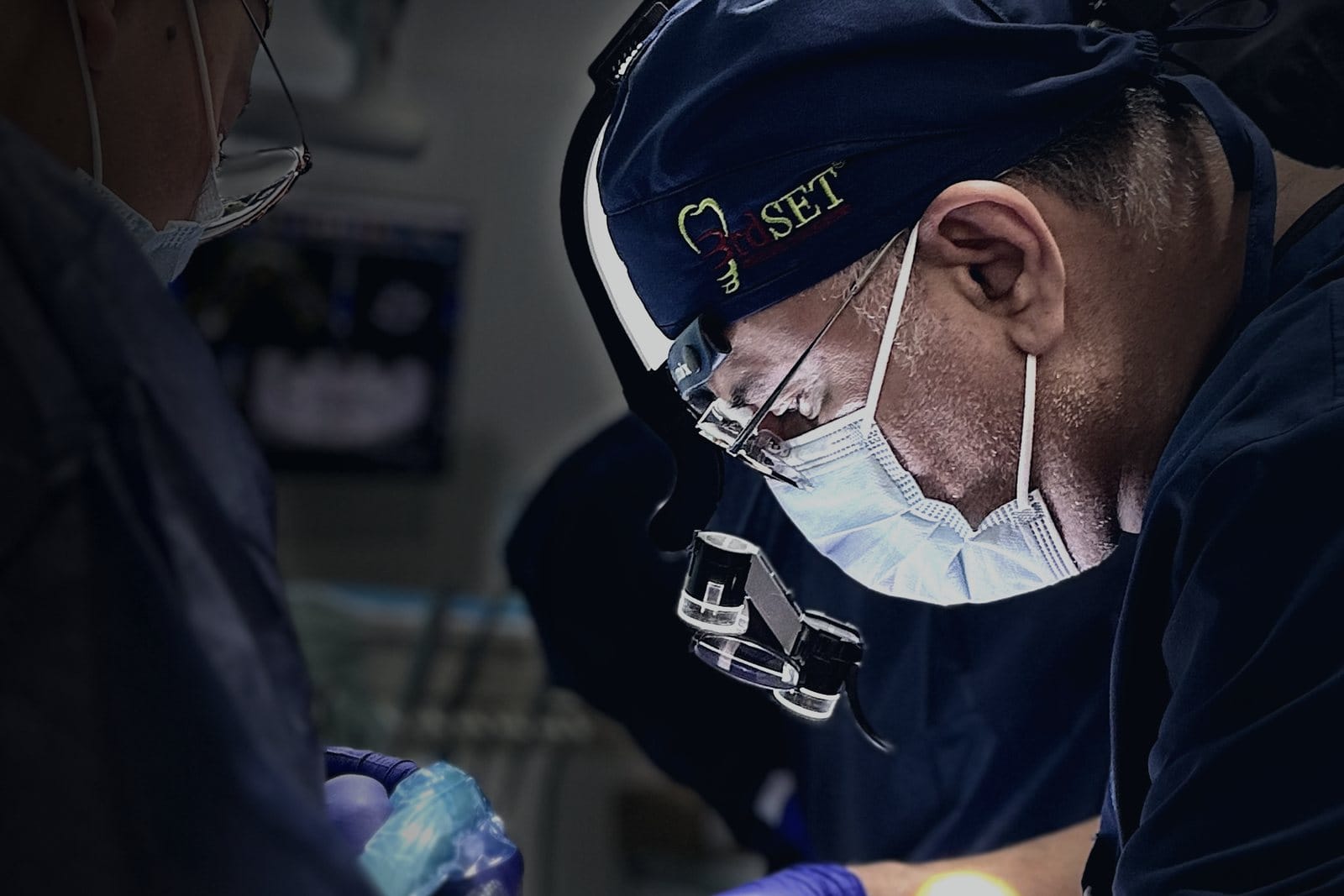
Short answer: live-patient implant training should put a licensed dentist in a supervised surgical setting where case planning, patient management, implant placement, and post-op judgment happen together — with mentors correcting technique while the procedure is still in progress.
General dentists do not search for "inspirational CE." They search when they are deciding whether to keep referring implant cases out or build the skill to place selected cases themselves. That decision usually lands on a narrower question: will this course give me enough supervised live surgery to transfer back into my own practice, or will I mostly watch someone else operate?
This guide is a buying framework for that question. It starts with vendor-neutral evaluation criteria — surgical access, supervision model, case selection, patient safety, CE accreditation, and total cost of attendance — then uses the 3rdSET live-patient implant training course as one concrete example of how those criteria can look when a program publishes numbers. For a broader comparison of all implant CE formats, pair this article with how to choose a dental implant training program and 9 ways to evaluate dental implant CE programs.
What "live-patient implant training" actually means
Live-patient implant training is supervised continuing education in which the participant places implants on consenting patients in a clinical setting. It is not a lecture with a few demo slides. It is not a typodont exercise where plastic bone never bleeds. It is not a cadaver lab where anatomy is excellent but soft tissue does not behave like a living patient.
The format exists because implant placement is a motor and judgment skill. You can understand osteotomy sequencing from a slide deck and still freeze when the ridge is narrower than expected, the soft tissue is thin, or the patient is anxious. Live-patient training compresses those variables into days of supervised reps so the workflow starts to feel automatic.
Useful programs connect four layers in the same week:
- Diagnosis and planning — CBCT review, restorative goals, risk flags, and why a case is or is not appropriate for your current skill level.
- Surgical execution — flap design, osteotomy, implant depth and angulation, primary stability judgment, and soft-tissue management under mentor eyes.
- Intraoperative correction — real-time feedback before an irreversible step becomes a complication story.
- Post-op and transfer thinking — instructions, complication awareness, grafting decisions, and what belongs back in your practice versus with a specialist.
If a brochure uses the phrase "live patient" but the participant mostly observes, the marketing and the product are not the same thing. Press for the per-doctor placement count.
Why general dentists look for this format
Most general dentists already diagnose implants, discuss options with patients, and restore implants placed by specialists. The gap is surgical confidence on straightforward cases — single-tooth sites with adequate bone, clear restorative plans, and manageable soft tissue. Referring every surgical case out is clinically fine; it is also a practice-design choice that leaves production and continuity of care on the table.
Live-patient training fits dentists who:
- Refer implant surgery today and want a supervised on-ramp before placing in-office.
- Completed lecture or typodont CE and realized they still lack surgical motor memory.
- Own or associate in a practice adding implants as a service line and need volume, not another certificate.
- Are early-career or new graduates with extraction comfort and an active license, but little or no implant placement history.
It is a poor fit for dentists who want a weekend certificate without surgical responsibility, or who are not yet comfortable with extractions and sterile surgical workflow. Beginner-friendly does not mean foundation-free. For first-year case selection mindset, see implant training for beginner dentists.
Vendor-neutral criteria: how to evaluate live-patient programs
Before you look at any provider's branding, score programs on the same checklist. Specificity is the filter. Vague promises fail the filter.
1. Per-participant surgical repetitions
Ask in writing: How many implants will I personally place? Not how many the faculty places. Not how many the group places. Not how many "cases" are available in the clinic that week. Your motor memory only counts your hands.
A single-digit personal count is an introduction. Double-digit counts across multiple surgical days are where sequencing, angulation correction, and soft-tissue handling start to feel familiar. Programs that cannot or will not give a per-doctor range are asking you to buy hope.
2. Mentor-to-participant ratio during surgery
Lecture faculty and surgical mentors are not the same role. What matters is how many mentors are chairside while you operate. A two-mentor, five-surgeon model is a different product from one celebrity instructor rotating among a large group. Ask who is physically present in the operatory on surgical days, and whether mentors stay for every case or only the difficult ones.
3. Case selection and assignment transparency
Good live-patient training matches cases to skill. You should understand why a site is appropriate before the handpiece starts. Ask how patients are screened, how cases are assigned, what imaging is reviewed with participants, and how the program handles cases that exceed a participant's current comfort. Referral boundaries taught during the course are a feature, not a failure.
4. Patient safety and clinical infrastructure
Live surgery implies informed consent, a licensed host facility, sterilization protocols, emergency readiness, and a plan for patient follow-up after the course week ends. Ask for those details in writing. International programs can be legitimate when those pieces are documented; legitimacy is specifics, not geography. Programs that dodge facility, consent, or follow-up questions should drop off your shortlist.
5. Curriculum that includes planning and complications — not only placement
Placement without planning produces expensive holes. Look for CBCT diagnosis, restorative thinking, material selection, bone-density recognition, immediate versus delayed decision frameworks, grafting awareness, and postoperative complication discussion. The goal is judgment under supervision, not a weekend of "I placed something."
6. CE accreditation you can verify
Confirm the accreditor (AGD PACE or ADA CERP are the common standards), the issuing organization, the subject code (AGD 690 for implants is typical), and your state board's acceptance rules. Logos on a landing page are not verification. Call or look up the provider independently.
7. Total cost of attendance, not sticker price
Add tuition, airfare to the meeting city, lodging, meals, implant and instrument fees, materials, ground transport, companion costs if relevant, and days of lost production. An all-inclusive higher tuition can beat a cheaper base price with nickel-and-dime add-ons. Run the arithmetic before you compare "value."
8. Transfer back into practice
Ask what happens after the course. Do graduates leave with a realistic first-case profile? Is restorative follow-through discussed? Is there any post-course mentorship path? The best training week fails if you return home and wait six months to place your first implant. Schedule early, appropriate cases before you leave.
For a longer rubric across weekend courses, continuums, and intensives, use the checklist in 9 ways to evaluate dental implant CE programs. For hands-on format categories available to US dentists, see top hands-on dental implant CE programs.
Supervision models: what "chairside mentorship" should look like
Supervision is the product. Without it, live-patient CE is just unsupervised surgery with travel. Strong models share a few traits:
- Mentors are present for treatment planning, not only for photo opportunities.
- Correction happens mid-procedure — angulation, depth, flap design, soft-tissue handling — before the implant is seated.
- Participants verbalize the plan: restorative goal, implant size, depth target, and contingency if primary stability is poor.
- Group size stays small enough that mentors can actually reach every chair.
Weak models look different: large groups, mentors who appear for opening lectures then disappear, "live surgery" that is mostly demonstration, or case assignment that dumps complex anatomy on first-time placers without scaffolding.
When you speak with a coordinator, ask them to describe a typical surgical day minute-by-minute. Vague answers are data.
Case selection: the skill that protects patients and practices
The first win of good live-patient training is not a heroic full-arch. It is learning which cases belong in your hands next month. Case selection includes bone volume and density, soft-tissue phenotype, adjacent tooth and prosthetic constraints, medical history flags, parafunction, and the restorative plan that the implant must serve.
A program that only celebrates aggressive cases can train courage without training judgment. Prefer programs that teach:
- When to delay placement after extraction.
- When guided bone regeneration changes the sequence.
- When sinus anatomy or ridge deficiency should trigger referral.
- How immediate versus delayed placement decisions are made on real imaging, not slogans.
That judgment is what lets a general dentist keep appropriate cases in-house without overreaching. If your practice goal is retaining implant revenue while staying clinically honest, read best implant CE for dentists who want to keep cases in-house.
Patient safety and what to ask before you enroll
Dentists evaluating live-patient CE should ask operational questions the same way they would ask about a hospital OR privilege:
- Who screens patients medically and dentally?
- How is informed consent documented, and in what language?
- What imaging is available on site?
- What is the sterilization and instrument workflow?
- Who provides emergency coverage during surgical days?
- Who follows the patient after the course cohort leaves?
- What happens if a complication occurs during your case?
You are not being difficult by asking. You are verifying that the educational setting is a clinical setting. Programs built for high-volume supervised learning should be able to answer without improvisation.
CE credit: records matter, but they are not the skill
Continuing education credit is necessary for licensing records and sometimes for malpractice conversations. It is not proof you can place implants. Evaluate credit and skill separately.
For credit: confirm accreditor, issuer, hours, subject code, and board acceptance. For skill: confirm reps, mentor ratio, and case-selection teaching. A course with many credit hours and few personal placements is a paperwork win and a clinical miss. A course with strong surgical volume and clear accreditation is the combination most practice owners actually want.
One concrete example: how 3rdSET structures live-patient training
The criteria above are vendor-neutral. Here is how one intensive program maps to them, using only published course facts. Confirm current dates and seat counts on the implant courses page, because availability changes.
Format and location
3rdSET runs a 4-day live-patient surgical course, Wednesday through Saturday, in Tijuana, Mexico. The group meets at San Diego International Airport around midday on day 1 and travels together by van; border crossing uses a medical fast-pass with SENTRI lane access. Day 1 covers travel, hotel check-in, and introductory lectures. Days 2–4 are live surgery roughly 9:00am to 8:00pm with a lunch break, followed by group dinner.
Surgical volume and supervision
Hands-on participants place approximately 20–30 implants across the surgical days, varying with clinical skill, case complexity, and pace. Courses are capped at 5 hands-on dentists with 2 mentors — a 2:5 mentor-to-clinician ratio — with both instructors mentoring directly at chairside throughout surgical sessions. Instructors are Dr. Farid Ebrahim, DDS, and Dr. Farshad Athari, DDS (both Northwestern-trained).
Who it is built for
The course is aimed at beginner to intermediate general dentists. Roughly 60% of participants have never placed an implant before. Prerequisites are an active dental license and the ability to perform extractions. New graduates are welcome when those prerequisites are met.
Seat types, tuition, and CE
- Hands-On Surgeon — $16,000, all-inclusive, 36 CE credits, 5 seats per course. Performs the surgery.
- Observer — $3,000, 22 CE credits, up to 2 seats per course. Observes live surgeries and treatment planning; does not operate.
- Surgical assistant and companion options exist; companion terms are on the Terms page, and assistant pricing comes from a coordinator.
CE credits are provided through MINEC America (AGD PACE accredited, AGD Code 690 – Implants). Confirm your board accepts that provider for the credit type you need.
What tuition covers
Implants and instruments, 4 nights hotel, all scheduled meals on course days, dental materials and disposables, and round-trip ground transportation from San Diego International Airport plus local transfers between clinic, hotel, and restaurants. Not covered: airfare to and from San Diego, beverages beyond meal service, and hotel incidentals.
Curriculum topics covered during the week
Treatment planning and case selection; CBCT diagnosis using imaging and live patient visuals; flap design and soft tissue releasing; surgical kit selection and orientation; material selection by clinical scenario; guided bone regeneration (GBR); identifying bone densities; immediate versus delayed placement and immediate load; sinus lift; and postoperative complication management.
For an intensive-format cost and schedule deep dive, see best intensive implant CE course for general dentists. For placement-course evaluation specifically, continue with implant placement course for general dentists.
A practical day-by-day mental model
Regardless of provider, most well-run intensives share a shape. Day 1 is travel, orientation, and planning language — so the group shares vocabulary before surgery. Midweek days are long operatory days: review the case, state the plan, operate with correction, debrief. Evenings often include informal case discussion that turns into the most honest teaching of the week. The final day consolidates complications, restorative handoff, and "what you place first when you get home."
Use that mental model when a coordinator describes their schedule. If their week has almost no protected planning time, or almost no protected surgical time, the balance is off.
After the course: protecting the investment
Live-patient reps decay without use. Dentists who return and immediately schedule straightforward, well-screened cases keep the skill. Dentists who wait months usually feel like beginners again. Before you enroll, plan:
- Which first-month cases in your own practice fit a conservative profile.
- How your team will present implant options and schedule surgery days.
- Which restorative workflows you already trust.
- When you will refer — and how you will explain that decision to patients.
Training buys a supervised runway. Practice systems decide whether the plane takes off.
Common red flags in live-patient CE marketing
- Group implant totals presented as if they were your personal count.
- "Unlimited implants" language with no mentor-ratio disclosure.
- Faculty names that do not match who is present during surgery.
- No clear answer on patient consent, follow-up, or host facility licensing.
- CE logos without a named issuing organization you can verify.
- Pressure to enroll before you receive numbers in writing.
- Curriculum that skips restorative planning and complication management.
If two programs look similar on Instagram and only one can answer the checklist above, choose the specific one.
How this connects to related decisions
Live-patient training is one format among several. Lecture CE builds vocabulary. Typodont and model courses build early motor patterns. Cadaver courses build anatomy confidence. Mini-residencies and continuums spread learning over months. Intensives compress volume into consecutive surgical days. The right choice depends on your current skill, time away from practice, and how quickly you need supervised reps. Start with format fit, then score providers inside that format.
If you already know you want supervised surgery and are comparing placement-focused curricula, read the companion guide on choosing an implant placement course for general dentists. If you want the high-level "why learn implants at all" framing for your team, see 5 reasons why every dentist should learn placing implants.
Bottom line
The best live-patient implant training is specific. It tells you who teaches, who supervises during surgery, how patients are selected, how many dentists attend, how many implants you should expect to place, what CE is issued through which organization, and what tuition includes. Specificity is what makes a course worth considering — and what makes educational content useful to a dentist making a real purchase decision.
When you are ready to compare a live-patient option against your shortlist, review current dates, seat types, and registration details on the hands-on dental implant CE course page, or book a call with a coordinator if you want fit and logistics clarified before you reserve a seat.
Questions to ask a live-patient program coordinator
Use these questions on a call or in email. Good programs answer them without improvisation. Weak programs pivot to testimonials.
- How many implants does a typical hands-on participant place, as a personal range?
- How many mentors are physically present in the operatory during surgical sessions?
- How many hands-on dentists share those mentors in one course cohort?
- How are patients screened medically and dentally, and who assigns cases?
- What imaging do participants review before operating?
- What is included in tuition, line by line?
- Which organization issues CE credits, under which accreditor, and for how many hours per seat type?
- What is the patient follow-up plan after the course week ends?
- What does a first-month case profile look like for a dentist who has never placed before?
- Can I speak with a recent graduate in a practice similar to mine?
Write the answers down. Compare them side by side with the second program on your shortlist. The spreadsheet is more honest than memory after three marketing calls.
Hands-on versus observer: choosing the right seat
Not every dentist needs to operate on the first trip. Some clinicians want to study workflow, mentoring style, and case pacing before committing to a surgical seat. Observer seats can be useful when:
- You want to evaluate the teaching culture before investing in a hands-on tuition.
- Your schedule or licensing timeline makes observation the right first step.
- A practice partner is assessing whether the whole team should build implant capacity.
Observer seats should still include treatment planning sessions and live surgery observation — not hallway waiting. Hands-on seats should include the scalpel, not a promise that "you might place if time allows." Clarify seat rights in writing. In the 3rdSET example, hands-on seats are $16,000 with 36 CE credits and perform surgery; observer seats are $3,000 with 22 CE credits and do not perform procedures.
Travel logistics without the mystery
International live-patient courses succeed or fail on logistics as much as pedagogy. Before you book airfare, confirm the meeting point, border process, hotel nights included, meal schedule, and what happens if a flight delay makes you miss the group van. For the 3rdSET itinerary, the published shape is meet at San Diego International Airport around midday on day 1, travel by van to Tijuana, hotel check-in, lectures, then three long surgical days. Airfare to San Diego is the participant's responsibility; ground transport from the airport and local transfers are included in hands-on tuition.
Build buffer into travel. Surgical days are long. Arriving exhausted into day-one lectures is a poor start. Confirm passport validity, any required entry documents, and your practice coverage for the days you are away — including emergency call arrangements for your own patients at home.
Building a first 90-day implant placement plan after training
Use the course as the start of a practice project, not the end of a CE checklist. A simple 90-day plan looks like this:
- Days 1–14: debrief with your team, update your case-selection rules, and identify three to five patients already in your charts who fit a conservative first-case profile.
- Days 15–45: complete planning, imaging review, consent conversations, and surgical scheduling for those early cases while the course sequencing is still fresh.
- Days 46–90: place, restore or provisional appropriately, document outcomes, and refine which case types you keep versus refer.
If your market needs implants but your charts are thin on ready cases, start the patient education and diagnosis workflow before you travel. Training without a pipeline is how dentists lose momentum.
How live-patient training interacts with restorative reality
General dentists live in restorative dentistry. Implant surgery that ignores the final prosthesis creates problems you will own for years. Strong live-patient courses keep restorative goals visible: emergence profile thinking, depth relative to the planned restoration, angulation that a stock or custom abutment can serve, and occlusal awareness for parafunctional patients.
You do not need to master every prosthetic nuance in one week. You do need to leave understanding that the implant is a foundation for a tooth, not a trophy photo. If a program never mentions the restoration until the closing lecture, say so out loud and ask them to show how restorative planning appears in daily case reviews.
How to shortlist programs in one week
If you are comparing live-patient implant training under time pressure, use a one-week process:
- Day 1: write your goal in one sentence (example: "Place straightforward single-tooth implants in-house within 90 days").
- Day 2: list three programs and request per-participant implant counts, mentor ratios, inclusions, and CE issuer details in writing.
- Day 3: build total-cost worksheets including lost production.
- Day 4: speak with one alumni from each finalist practice size similar to yours.
- Day 5: score finalists on the vendor-neutral checklist in this article.
- Day 6: confirm board CE acceptance and travel logistics.
- Day 7: choose, or decide you need a different format first (cadaver, continuum, or more extraction experience).
Speed is fine. Skipping numbers is not. Dentists who enroll from a single webinar pitch are the ones most likely to feel mismatched on day two of surgery.
Ethics and professionalism in high-volume learning environments
High surgical volume is educationally valuable only when patient welfare stays first. Participants should expect — and demand — that case assignment respects informed consent, medical screening, and skill-matched difficulty. If a program culture rewards speed over judgment, leave that culture on the table even if the implant count looks attractive.
Your professional identity after the course should still sound like a careful general dentist: clear indications, honest referral, restorative responsibility, and documented follow-up. Volume is a training tool. It is not a personality.
Frequently asked questions
What is live-patient implant training?
Live-patient implant training is supervised continuing education in which a licensed dentist places implants on consenting patients in a clinical setting, with mentors correcting technique in real time. It differs from lecture, typodont, and cadaver formats because it includes bleeding, soft-tissue behavior, anesthesia, patient management, and irreversible surgical decisions.
How many implants should I personally place in a live-patient course?
Ask for the per-participant count in writing, not a group total. A single-digit personal count is an introduction. Programs that put a dentist into the double digits across several surgical days give enough repetition for workflow and motor memory to start sticking. As one concrete example, 3rdSET targets roughly 20–30 implants per hands-on participant across four days.
Is live-patient implant training appropriate for beginners?
Yes, when prerequisites are honest: an active dental license, comfort with extractions, and willingness to accept chairside correction. Beginner-friendly programs still screen for surgical fundamentals. In many intensive live-patient courses, a large share of participants have never placed an implant before; the format works when case selection matches skill level and mentors stay chairside.
What mentor-to-participant ratio should I look for?
During live surgery, mentor access matters more than lecture charisma. Ask how many mentors are physically present in the operatory while you operate, not how many names appear on the brochure. A small course with two mentors and five surgeons is a very different supervision model from one mentor rotating among a dozen operators.
What CE credits do live-patient implant courses typically offer?
Credit hours and accreditors vary by provider. Look for AGD PACE or ADA CERP recognition and an implant-appropriate subject code (AGD code 690 is common). Confirm which organization issues the credits and that your state board accepts them. As one example, 3rdSET hands-on seats earn 36 CE credits through MINEC America (AGD PACE); observer seats earn 22.
How should I compare total cost of live-patient implant training?
Add tuition, airfare, lodging, meals, implant and instrument fees, materials, ground transport, and days of lost production. An all-inclusive tuition can cost less overall than a cheaper sticker price with add-ons. Ask what is included in writing before you compare programs.
Where can I see current live-patient implant course dates?
Availability changes as seats fill. For 3rdSET, confirm current dates, seat counts, and registration options on the implant courses page rather than relying on an older blog post. Use that page for November and later availability, waitlists, and seat types.