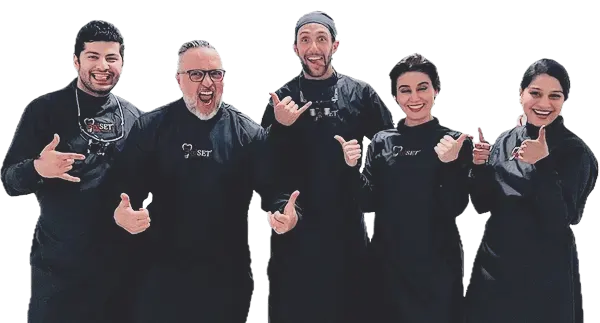
3rdSET CE at a glance: a live-patient program rather than a lecture, typodont, or cadaver course. Four surgical days in Tijuana, Mexico, roughly 20–30 implants placed per participant, groups capped at five dentists with two mentors, and 36 CE credits through MINEC America under AGD PACE, AGD code 690. Tuition is $16,000, all-inclusive.
Most dentists begin the search the same way: a search query, a row of price tags, and a scroll through course photos. But the question that actually decides whether the money was well spent is not which implant program is the best. It is what will I be able to do, unsupervised, on the Monday after I get home?
Almost no course page answers that directly. This guide is a framework for answering it yourself: how the main training formats differ in what they genuinely deliver, the ten criteria that separate a strong program from an expensive one, a scoring rubric you can run on any two options side by side, and the questions worth asking before you send a deposit.
Start with the outcome, not the brochure
Before you compare a single program, write down the clinical capability you are buying. Being specific here filters out most of the market immediately, because programs are built for very different end states.
Three realistic competency tiers
- Tier 1 — Predictable single-unit placement. Screen and select a straightforward case, place an implant in a healed, non-esthetic site, suture, manage the post-op, and know when to refer. This is where the overwhelming majority of general dentists should be aiming first.
- Tier 2 — Expanded surgical judgment. Immediate placement into extraction sockets, simple guided bone regeneration, and esthetic-zone decision-making.
- Tier 3 — Advanced reconstruction. Sinus augmentation, block grafting, full-arch and complex prosthetic sequencing.
A course that markets Tier 3 cases to a Tier 1 clinician is not being generous with your money. Watching a full-arch case is entertaining; it does not make you competent at the single-unit case that will actually walk into your practice next week. Our guide to implant training for beginner dentists goes deeper on why first-year case selection matters more than case complexity.
Write it down first. “I want to place straightforward single-unit implants confidently and know exactly when not to” is a specification you can hold a program against. “I want to learn implants” is not.
The five formats of implant training — and what each actually delivers
“Hands-on” is the most overworked phrase in dental CE. It is applied to courses where you handle a drill for twenty minutes and to courses where you perform surgery for four days. These are the five formats you will encounter, and what each one honestly produces.
1. Lecture and weekend CE
Didactic teaching, case presentations, and treatment planning. Genuinely valuable for theory, diagnosis, and understanding complications you have not yet met. It builds knowledge, not motor skill. Treat it as a prerequisite rather than a destination.
2. Model and typodont workshops
Drilling sequences and placement on resin models or synthetic bone. Excellent for learning osteotomy protocol, drill sequencing, and the feel of a torque wrench without consequence. The limitation is that synthetic bone is uniform and forgiving in a way real bone is not, and there is no soft tissue, bleeding, or patient to manage.
3. Cadaver courses
Strong anatomical grounding, realistic tissue planes, and the freedom to attempt techniques you could not ethically rehearse on a living patient. What a cadaver cannot give you is bleeding, anesthesia, healing, patient communication, or the weight of an irreversible decision made on a person who will return for a follow-up.
4. Mini-residencies and continuums
Multi-session programs running over months, usually blending didactics with progressively harder clinical work. The spaced structure is pedagogically excellent — repetition distributed over time retains better than a single burst. The trade-offs are total cost, repeated travel, and long gaps between sessions where skills fade.
5. Live-patient programs
Supervised surgery on consenting patients. This is the only format that closes the gap between knowing the protocol and performing it under real conditions. Quality varies enormously, which is exactly why the criteria in the next section matter: a live-patient course where you place two implants is a very different product from one where you place twenty.
| Format | Hands-on reps | Supervision | Relative cost | What it actually prepares you for |
|---|---|---|---|---|
| Lecture / weekend CE | None | N/A | Lowest | Diagnosis, treatment planning, theory |
| Model / typodont | Unlimited, synthetic | Group | Low | Drill sequencing and osteotomy protocol |
| Cadaver | Moderate | Usually group | Moderate | Anatomy, flap design, advanced technique rehearsal |
| Mini-residency | Varies widely | Varies widely | High (cumulative) | Broad, structured knowledge over months |
| Live patient | Real, countable | Ratio-dependent | Highest per session | Performing surgery under real clinical conditions |
Costs are relative rather than absolute — always compare total cost of attendance, not the advertised tuition. See criterion 7.
Ten criteria for evaluating any implant training program
These apply regardless of format, country, or price. Work through them in order; the first three eliminate most candidates on their own.
1. Live-patient surgical reps per participant
This is the single most predictive number, and the one most often obscured. Course pages advertise how many implants the group places, or how many the instructor demonstrates. Neither is the number that matters. Ask precisely: how many implants will I personally place, hands on the handpiece, from incision to suture? Get it in writing. A course that will not commit to a figure is telling you something.
2. Participant-to-mentor ratio
Mentorship does not scale. In a group of twenty with two instructors, you receive a few minutes of individual correction across an entire course — and correction at the moment of the mistake is the entire mechanism by which surgical skill improves. Small course groups cost more per head for a reason. Ask for the exact ratio and the maximum course group size, not the average.
3. Who is actually teaching — and are they still operating
Named instructors with verifiable credentials and an active surgical practice. A clinician who still places implants weekly teaches differently from one who stopped a decade ago: they have current complications, current materials, and current judgment. Look them up independently. If a program will not name its faculty until after you register, that is your answer.
4. Curriculum scope matched to your tier
Check the syllabus against the competency tier you defined at the start. A Tier 1 clinician wants depth on case selection, osteotomy protocol, primary stability, flap management, suturing, and post-op care. Coverage of immediate placement, guided bone regeneration, or sinus lifts is a bonus — but not at the expense of the fundamentals. Depth beats breadth every time in a first surgical program.
5. Case selection and patient screening protocol
Ask how patients are screened and who decides which case you are assigned. A serious program has explicit medical and anatomical inclusion criteria and matches case difficulty to participant experience. A program that hands a first-time surgeon a compromised site is optimising for a dramatic photograph, not your learning. This is also where evidence-based protocol shows up in practice — decisions like how deep to place relative to the bone crest should be taught with reference to the literature, not house habit.
6. CE accreditation your board actually accepts
Look for AGD PACE or ADA CERP recognition and an implant-appropriate AGD subject code (690). Then do two verification steps most people skip: confirm which organisation actually issues the credits and check that organisation independently, and confirm your own state board accepts that provider for the credit type you need. A logo on a landing page is a claim, not proof.
7. What tuition actually includes — and the hidden costs
Compare total cost of attendance, not sticker price. Build the real number: tuition, flights, lodging, meals, ground transport, implant and component fees, instrument or kit charges, and the production you forgo by closing the practice. Programs quoting a low tuition frequently bill implants, materials, and instrumentation separately. An all-inclusive program with a higher headline figure is sometimes the cheaper choice once the spreadsheet is honest.
8. Restorative follow-through and post-course support
Placing the implant is half the service you are selling patients. Ask what the program teaches about the restorative phase, and — just as important — what happens after you fly home. Is there a mentor you can send a CBCT to when you meet a case you are unsure about? Ongoing access to the people who trained you is worth more than an extra day of lecture.
9. Patient safety, informed consent, and ethics
Any legitimate live-patient program should be able to describe, without hesitation: the licensed facility where surgery occurs, the supervising clinicians of record, the written informed-consent process explaining that a visiting dentist will operate under supervision, sterilisation and emergency protocols, and how patients receive follow-up care after the course ends. Ask directly. Hesitation on this topic is disqualifying — there is no acceptable version of a vague answer here.
10. Verifiable outcomes
Look past the testimonial carousel. Can you speak to a past participant who is not a paid ambassador? Are there documented cases with follow-up rather than just immediate post-op photographs? Are reviews attached to real, findable clinicians? Search for the program name outside its own website. Our participant reviews are one example of what attributable feedback looks like — apply the same standard everywhere.
Score any program out of 100
Run two or three candidates through this and the decision usually makes itself. Weight the criteria by how much each one moves your actual outcome.
| Criterion | Weight | Score 1–5 | Weighted |
|---|---|---|---|
| Live-patient reps per participant | ×5 | /25 | |
| Participant-to-mentor ratio | ×4 | /20 | |
| Faculty credentials and active practice | ×3 | /15 | |
| Curriculum matched to your tier | ×2 | /10 | |
| Case selection and screening | ×2 | /10 | |
| Accreditation your board accepts | ×1 | /5 | |
| True total cost of attendance | ×1 | /5 | |
| Post-course mentorship access | ×1 | /5 | |
| Safety, consent, and ethics | ×1 | /5 | |
| Verifiable outcomes | ×0.5 | /2.5 |
Anything scoring below 60 is unlikely to change your clinical capability, whatever it costs. Below 40, you are buying a certificate.
Twelve questions to ask before you send a deposit
Send these by email so the answers are in writing. How a program responds is itself informative — specific numbers come back quickly from confident organisers.
- How many implants will I personally place, from incision to suture?
- What is the maximum course group size, and how many mentors are present during surgery?
- Who are the supervising clinicians, and are they currently in surgical practice?
- How are patients screened, and who assigns cases to participants?
- What happens if my assigned case is cancelled or fails screening on the day?
- Which organisation issues the CE credits, and under what accreditation?
- What exactly is included in tuition, and what will I be billed for separately?
- Is the surgical facility licensed, and who is the clinician of record?
- What does the patient consent form say about who performs the surgery?
- How do patients receive follow-up care after the course ends?
- What mentorship is available to me after I go home, and for how long?
- Can you connect me with two past participants I can speak to directly?
Red flags that should end the conversation
- No per-participant rep count. Deflection to group totals or instructor demonstrations.
- Unnamed faculty until after payment, or instructors with no verifiable surgical practice.
- Vague answers on consent and supervision. The single most serious warning sign in live-patient training.
- Accreditation that cannot be verified with the issuing organisation directly.
- Pressure closes. Countdown timers, expiring discounts, and “one seat left” urgency applied to a five-figure clinical decision.
- Tuition that unbundles after you commit — implants, instruments, and materials appearing as surprise line items.
- Testimonials with no attributable name or practice behind them.
What this looks like in practice
To make the framework concrete, here is how we would expect a reader to score our own program — including where it will not suit everyone.
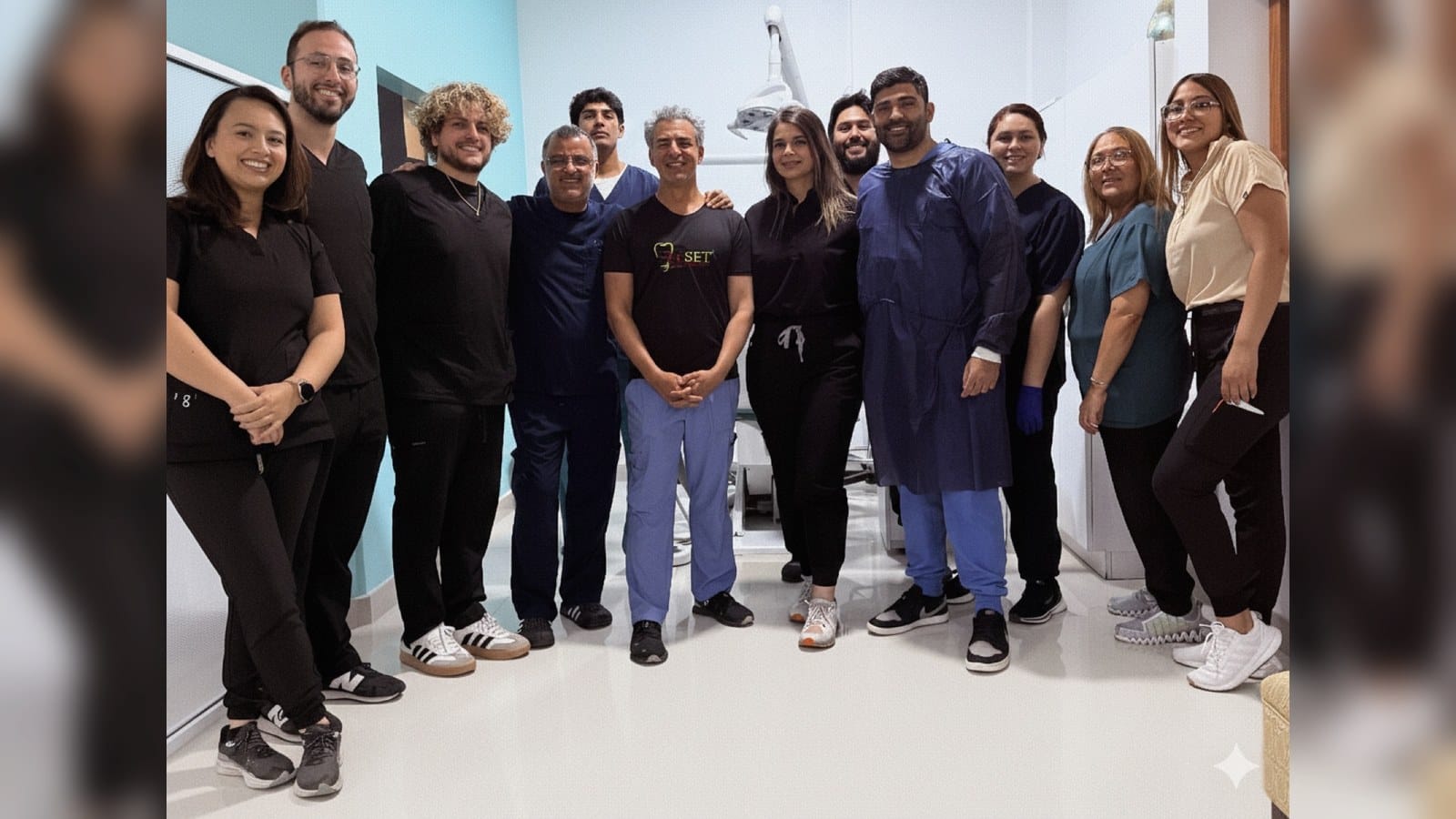
The 3rdSET hands-on dental implant CE course runs as a four-day live-patient program in Tijuana, Mexico. Participants place roughly 20–30 implants each, course groups are capped at five dentists with two mentors, and the course carries 36 CE credits issued through MINEC America under AGD PACE, AGD code 690. Tuition is all-inclusive: implants, instruments, lodging, meals, materials, and ground transport. Faculty are Dr. Farid Ebrahim and Dr. Farshad Athari, both Northwestern-trained and both still operating. Around 60% of participants have never placed an implant before.
Where it will not fit: it requires international travel and a valid passport, it is a concentrated four-day format rather than a spaced continuum, and a clinician who already places routinely and wants Tier 3 reconstruction should look at a more advanced program instead. If you have already narrowed your search to live-patient courses, our breakdown of what to compare across live-patient implant courses covers the specifics.
Score any program this way — ours included — and you will end up with a defensible decision rather than a hopeful one.
Frequently asked questions
How do practice owners choose a live-patient implant course?
Practice owners should choose a live-patient implant course by checking per-participant implant placement volume, participant-to-mentor ratio, faculty credentials, patient screening, informed consent, CE accreditation, total cost of attendance, and post-course support. The strongest option is usually the course that gives the owner enough supervised live surgery to bring appropriate cases back into the practice without overextending clinically.
What is the best way to find reputable implant CE courses?
The best way to find reputable implant CE courses is to build a shortlist from recognized CE providers, dental organizations, university programs, and live-patient training institutes, then verify each program's faculty, accreditation, facility, informed-consent process, participant-to-mentor ratio, and expected implant placements per participant in writing.
How do dentists choose a good implant continuing education course?
Dentists choose a good implant continuing education course by matching the program to their current skill level and confirming that it teaches case selection, surgical planning, live or realistic hands-on repetition, complication management, restorative thinking, and board-acceptable CE credit. For dentists who want to start placing implants, direct mentorship and live-patient reps matter more than lecture hours alone.
How many implants should I place during a hands-on implant course?
There is no universal standard, but the number you place — not the number the group places — is what builds motor memory. A single-digit rep count is an introduction. Programs that get a participant into the double digits across several days give you enough repetition for the workflow to start feeling automatic. Always ask for the per-participant figure in writing.
Is cadaver training as good as live-patient training?
Cadaver courses are excellent for anatomy, flap design, and practising techniques you cannot rehearse on a live patient. What they cannot reproduce is bleeding, live soft-tissue behaviour, anesthesia, patient management, and the pressure of an irreversible decision. Most clinicians benefit from cadaver work as a supplement to live-patient training rather than a substitute for it.
How much does dental implant training cost?
Costs vary widely by format. Lecture and weekend CE is typically the least expensive, model and cadaver workshops sit in the middle, and multi-day live-patient programs and mini-residencies are the largest investment. Compare total cost of attendance rather than the sticker price: add travel, lodging, meals, implant and instrument fees, and days out of the practice. An all-inclusive program with a higher headline number is sometimes the cheaper option once those are added.
Do I need a residency to place implants as a general dentist?
In most of the United States, implant placement falls within the general dentist's scope of practice and no specialty credential is required. Requirements are set state by state, so confirm the rules with your own dental board and your malpractice carrier before you begin placing — training requirements for coverage can differ from the licensing rules.
What CE accreditation should an implant course have?
Look for AGD PACE or ADA CERP recognition, and check that the course carries an AGD subject code appropriate to implants (code 690). Ask which provider issues the credits and verify that organisation independently, rather than relying on a logo on the course page. Then confirm your own state board accepts that provider for the credit type you need.
How long does it take to become confident placing implants?
Confidence tracks repetition and case selection more than calendar time. Clinicians who return from training and place straightforward, well-screened cases regularly tend to feel settled within their first several months. Clinicians who complete a course and then wait months for a first case usually lose most of what they gained and need to retrain.
Are international live-patient implant courses legitimate?
Many are, and they exist because patient access and regulatory frameworks abroad allow supervised placement volumes that are difficult to arrange domestically. Legitimacy comes down to verifiable specifics: a licensed host facility, named supervising clinicians, a documented informed-consent process, patient follow-up arrangements, and CE credits issued through a recognised accreditor. Programs that cannot produce those details in writing should be treated with caution.
The decision underneath the decision
Choosing an implant training program is really a decision about how much discomfort you are willing to buy. The comfortable options — lecture halls, models, watching an expert work — are cheaper, closer to home, and produce very little change in what you can do alone. The uncomfortable option is standing over a consenting patient with a mentor beside you, making the decision yourself, and being corrected in the moment.
Run the ten criteria. Score your shortlist. Ask the twelve questions and read the answers carefully. Then choose the program that produces the most repetitions of the thing you are actually afraid of — because that is the only part that transfers to Monday morning.
“Nobody becomes a surgeon by watching one. Pick the course that puts the handpiece in your hand the most times.”
— Dr. Farshad Athari, 3rdSET Implants