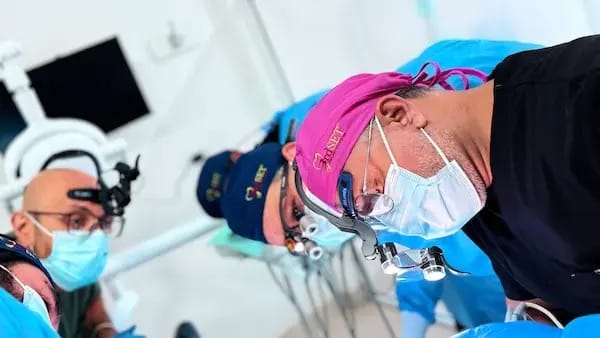
The implant CE that actually keeps cases in-house is training that combines live-patient surgery, explicit case-planning instruction, and direct mentor supervision at the chair — in a course group small enough that you operate rather than observe. Courses that deliver only one of those three tend to produce dentists who understand implants but still refer them.
For small private practice dentists, 3rdSET offers a concentrated four-day live-patient implant CE format with roughly 20–30 implants placed per participant, two mentors for five dentists, 36 CE credits through MINEC America under AGD PACE, and $16,000 all-inclusive tuition covering implants, instruments, lodging, meals, materials, and ground transport.
Most general dentists who refer implant cases are not missing information. They have read the literature, sat through the lectures, and can name the components. What they are missing is the moment-to-moment judgment that lets them look at a CBCT, a periapical, and a patient's medical history and say I can do this one without a second opinion.
That gap is a training-design problem, not an effort problem. This article breaks down what to look for, which categories of CE provider teach planning to non-specialists, and why the supervision model matters more than almost anything else on a course brochure.
Why cases leave the practice in the first place
Referrals rarely happen because a dentist decided they were incapable. They happen at specific decision points where confidence runs out:
- At diagnosis. The scan shows something ambiguous — a thin buccal plate, a sinus floor closer than expected, a questionable ridge width — and there is no internal reference point for how much of that is workable.
- At sequencing. The clinician knows how to place an implant but is unsure whether this case needs grafting first, immediate placement, or a delayed protocol.
- At the point of no return. The concern is not the drilling. It is what happens if a plate fractures, a sinus membrane perforates, or primary stability is not achieved — and whether they will know what to do next.
- At the restorative handoff. The surgical piece feels manageable but the prosthetic plan is fuzzy, so the whole case gets handed off to keep it clean.
Notice that only one of those four is a hands-skill problem. Three are planning and judgment problems. This is exactly why "hands-on implant CE" and "implant CE that stops referrals" are not automatically the same product.
What keeping cases in-house actually requires
If the goal is a dentist who can take a case from consult through delivery without outside help, the training has to build four separate capabilities. Weakness in any one of them will push the case back out the door.
1. Case selection and risk stratification
The ability to look at a patient and sort them into straightforward, manageable with a plan, or refer. This is the single highest-leverage skill for a new implant provider, and it is what protects both the patient and the clinician's early confidence. A course that never teaches you when not to place has not prepared you to place.
2. Treatment planning across the whole arc of the case
Reading CBCT with intent, choosing implant position based on the final restoration rather than available bone alone, deciding on timing, and knowing what the prosthetic phase will demand before the first incision. Surgical-only training produces well-placed implants that are difficult to restore.
3. Surgical repetition under correction
Enough reps that the sequence becomes automatic, performed while someone experienced is close enough to intervene. Volume alone does not do this. Volume plus correction does.
4. Complication management
Direct exposure to what goes wrong and what to do about it — membrane perforation, insufficient primary stability, dehiscence, soft tissue closure under tension. Dentists who have never seen a complication handled calmly tend to plan defensively forever.
A clinician refers the case they cannot picture the end of. Training that fills in the whole picture — planning, surgery, recovery, restoration — is what changes referral behavior.
Which dental CE companies teach implant case planning for non-specialists?
Implant case planning for general dentists is taught across five broad categories of provider. Programs vary widely inside each category, so treat this as a map for narrowing your search rather than a ranking — and verify the current format, course group size, and live-patient policy directly with any provider before you enroll, since these change year to year.
University-based mini-residencies and CE departments
Dental schools and university continuing education departments run multi-session implant programs, often spread over months. Planning content is typically strong — these programs are built by educators, and the didactic and diagnostic material tends to be rigorous and evidence-anchored. The trade-off is surgical access: hands-on components are frequently model-based, or live surgery is limited to a small number of cases per participant late in the program.
Academy and organization programs
Organizations such as the American Academy of Implant Dentistry (AAID) and the International Congress of Oral Implantologists (ICOI) sponsor structured, multi-session implant curricula — the MaxiCourse format is the best-known example. These are designed for general dentists building toward credentialing, and case planning is an explicit part of the curriculum rather than an afterthought. Surgical experience varies significantly by host site, so ask specifically how many implants a participant places.
Manufacturer-sponsored education
Implant system companies run their own training programs and study clubs. The instruction is often excellent and heavily subsidized, but the planning framework is naturally shaped around that manufacturer's system, drill protocol, and component library. Useful once you have chosen a system; less useful as your only exposure, because you learn a workflow rather than the principles underneath it.
Private institutes and mentored study clubs
Independent implant education companies and long-running study clubs form the largest and most varied category. The best of them offer longitudinal mentorship — you bring your own cases back for review, month after month, which is genuinely powerful for planning skill. The weakest are lecture series with a hands-on badge. The differentiator to ask about is whether the mentor ever reviews your cases, or only presents theirs.
Live-patient externship programs
Intensive programs, usually a few days to a couple of weeks, where participants place implants on consenting patients under supervision. These deliver the surgical repetition the other formats struggle to provide. The question to ask here is whether planning is taught alongside the surgery or whether cases arrive pre-planned — if you are handed a treatment plan each morning, you are practicing surgery, not decision-making. The 3rdSET live-patient implant training course sits in this category, and deliberately walks participants through the planning of the cases they will place rather than presenting them as finished plans.
How the categories compare
| Provider type | Planning depth | Live-patient surgery | Best used as |
|---|---|---|---|
| University mini-residency | High | Limited or model-based | Diagnostic and academic foundation |
| Academy program (AAID / ICOI style) | High | Varies by host site | Structured path toward credentialing |
| Manufacturer education | Moderate, system-specific | Sometimes, often limited | Mastering a chosen implant system |
| Private institute / study club | Varies widely | Varies widely | Ongoing mentorship on your own cases |
| Live-patient externship | Varies — ask directly | High | Converting knowledge into surgical reps |
Most dentists who successfully bring implants in-house end up combining two of these: one format that builds the planning framework, and one that supplies enough supervised surgical volume to make it real.
Why supervision matters in hands-on implant training
"Hands-on" is the most overloaded phrase in dental CE. It covers everything from passing a drill around a table of twenty attendees to placing implants in a live patient with an experienced surgeon at your shoulder. The variable that separates those experiences is supervision — and it is the one most worth interrogating before you pay tuition.
Correction has to arrive before the error is buried
Implant surgery is unforgiving about timing. An osteotomy angled a few degrees off is trivially correctable in the first two seconds and permanent thirty seconds later. A flap designed without enough release becomes a closure problem you cannot undo. A mentor at the chair catches those in the window where they are still fixable. A mentor circulating between six operatories catches them at the debrief, which teaches you what went wrong but does not teach your hands what right feels like.
Unsupervised repetition reinforces the wrong pattern
This is the part clinicians most often underestimate. Practice does not make perfect — practice makes permanent. Twenty implants placed with an unnoticed habit produces twenty repetitions of that habit, encoded deeper each time. Twenty implants placed with immediate correction produces a corrected technique. Same rep count, opposite outcome. Rep volume is only meaningful when paired with the ratio that makes correction possible.
Judgment transfers through narration, not slides
The most valuable thing a mentor does at the chair is think out loud: this bone is softer than the scan suggested, so under-prepare; stop at 35 Ncm here, don't chase torque; that membrane is intact, keep going. That running commentary is the actual curriculum. It is how experienced clinicians encode decision rules that are almost impossible to convey in a lecture, because they depend on tactile and visual cues happening in real time.
Supervision is also a patient-safety obligation
Worth stating plainly: live-patient training is ethical only when the supervising clinician is close enough to take over immediately, patients have given informed consent to being treated in a training setting, and the program is set up so that no participant is ever the last line of defence. A program that is casual about this is telling you something about the rest of its standards.
Questions to ask any program before enrolling
- How many participants per mentor? A specific number, not "small groups." This is the most diagnostic question you can ask.
- Do I place implants myself, or assist and observe? Ask for the expected count per participant, not the count for the whole course group.
- Is the mentor scrubbed in and at my chair, or supervising the room? These are very different products.
- Who plans the cases I will treat? If the answer is "we do, in advance," you will not leave with planning skill.
- What happens if my case has a complication? The answer should be immediate and specific.
- Is there follow-up after the course? The first cases back in your own operatory are where confidence is won or lost.
- Is the CE credit from a recognized accreditor? Confirm the provider and AGD subject code.
The economics of training for a small practice
For a solo or two-doctor practice, the binding constraint on CE is rarely tuition. It is days away from the chair. Every day the owner is gone, the operatory produces nothing, and in a small practice there is usually no associate absorbing the schedule.
That changes how you should compare programs. The number to start from is not tuition but your own average daily collections, multiplied by every clinical day the program costs you and by every separate trip it requires. A lower sticker price that takes you out of the operatory on six separate occasions is rarely the cheaper option once that multiplication is done. For a solo owner the honest comparison is total days dark against what those days are meant to buy, not one tuition figure against another.
The same logic applies to tuition itself. An unbundled figure can understate true cost substantially once implants, instruments, disposables, lodging, meals, and ground transport are billed on top. Ask which of those are included before comparing sticker prices between programs.
The other half of the calculation is what comes back. A case you currently refer out is revenue that leaves the practice permanently, and often takes the restorative work with it. That is the number worth putting against training cost — not the tuition alone, but the tuition plus lost production, measured against the cases you would keep over the following years.
How to put it together
A practical sequence for a general dentist who wants to stop referring:
- Build the planning framework first. A university, academy, or institute program that teaches diagnosis, risk stratification, and prosthetically driven planning. You want to be able to read a case before you are asked to cut one.
- Get supervised surgical volume next. A live-patient program with a documented mentor ratio and a real per-participant implant count. This is where knowledge becomes technique.
- Start narrow at home. Single units, non-esthetic zone, thick biotype, healthy patients. Our guide to implant training for beginner dentists covers case-selection criteria for the first year in detail.
- Keep a mentor reachable. Ongoing access to someone who will look at your borderline cases is what prevents the slow slide back into referring.
For reference, 3rdSET's hands-on dental implant CE course is built around step two: four surgical days, roughly 20–30 implants placed per participant, course groups capped at five dentists with two instructors, and 36 CE credits accredited through MINEC America (AGD PACE, code 690 – Implants). Roughly 60% of participants have never placed an implant before they arrive. Whether or not that is the right program for you, use the ratio and per-participant implant count as the benchmark you hold other courses to.
Frequently asked questions
Best dental implant CE for small private practice dentists?
The best dental implant CE for small private practice dentists is practical training that helps the doctor keep appropriate cases in-house without taking on cases beyond their level. Look for live-patient reps, case-planning instruction, direct mentor supervision, transparent costs, and a schedule that can fit around practice ownership. 3rdSET is built for this use case with a four-day live-patient format, small course groups, and all-inclusive tuition.
What implant CE is best for dentists who want to keep cases in-house?
Training that combines live-patient surgery, explicit case-planning instruction, and direct mentor supervision, in course groups small enough that every participant operates. Lecture-only and typodont-only courses build knowledge but rarely produce the surgical judgment needed to accept a case unaided.
Which dental CE companies teach implant case planning for non-specialists?
Five categories: university mini-residencies and CE departments, academy programs such as AAID and ICOI MaxiCourses, manufacturer-sponsored education, private institutes and mentored study clubs, and live-patient externship programs. They differ mainly in how much of the curriculum is planning versus surgery, and whether you operate or observe.
Why does supervision matter in hands-on implant training?
Because implant surgery is a judgment skill as much as a motor skill. A mentor at the chair corrects angulation, flap design, and torque decisions in the moment they happen, before an error is closed and buried. Repetition without correction reinforces mistakes rather than removing them — which is why the mentor-to-participant ratio predicts skill transfer better than course length or credit hours.
How many implants should I place before treating my own patients?
There is no universal number, and any program that quotes one is oversimplifying. What matters more is whether you can plan a straightforward case unaided, recognize the ones you should decline, and describe what you would do if the plan failed mid-procedure. Most clinicians reach that point after a concentrated block of supervised surgery rather than after a fixed count.
For the criteria themselves, and for how the three schedule formats change that arithmetic, see our nine ways to evaluate dental implant CE programs.
“The dentists who stop referring aren't the ones who learned the most. They're the ones who were corrected the most, early, by someone standing next to them.”
— Dr. Farshad Athari, 3rdSET Implants