3rdSET CE at a glance: measured against the nine criteria below — roughly 20–30 implants placed per participant, five dentists to two mentors chairside, four live-patient days in Tijuana, Mexico, and 36 CE credits through MINEC America under AGD PACE, AGD code 690. Tuition is $16,000, all-inclusive.
Comparing dental implant continuing education is difficult for an honest reason: every program describes itself in the same vocabulary. Comprehensive. Hands-on. Mentored. Small group. Those words are unregulated, so they cost a provider nothing to use and tell you almost nothing about what you will be able to do afterwards.
What separates programs is not their adjectives but their specifics — and specifics can be requested, compared, and verified before you spend anything. Below are nine criteria that reliably distinguish a program that changes your clinical capability from one that mostly fills a weekend. Each includes the question that produces a usable answer, because the single most informative thing you can do while shopping is ask a direct question and listen to how readily it gets answered.
Two notes before the list. First, weight these against your own goal: a dentist who wants to place straightforward single units in healed sites needs a different program than one aiming at immediate placement and grafting. Second, if you are still deciding between training formats — lecture CE, typodont workshops, cadaver courses, mini-residencies, live-patient programs — start with our companion guide on how dentists choose an implant continuing education course, then come back here to evaluate the specific programs on your shortlist.
1. Surgical repetitions you personally perform
This is the first question because it is the one most often answered at the group level. A program that says “our participants place over a hundred implants” is describing a room, not a dentist. What builds motor memory is the number you hold the handpiece for: your osteotomy, your angulation, your torque reading, your decision when the bone is softer than the CBCT suggested.
Hands-on implant surgery training also varies in what “hands-on” refers to. Placing into a typodont, a pig jaw, a cadaver, and a live patient are four genuinely different experiences, and only the last includes bleeding, anaesthesia, soft-tissue behaviour, and the weight of an irreversible decision on a person who will walk out of the operatory. All four have a place. They are not interchangeable, and a program that blurs the distinction in its marketing is telling you something.
Ask: How many implants will I personally place, on live patients, over the course? Put the per-participant number in writing.
2. Mentor-to-participant ratio in the operatory
Ratio is the criterion that quietly governs most of the others. It determines whether a mentor corrects your angulation while the drill is still in the bone or reviews it afterwards from a photograph, whether you get an individual answer or a general one, and how many repetitions can physically fit into the schedule.
Note the phrase “in the operatory.” Programs frequently quote total faculty — a roster of ten names, most of whom lecture and none of whom are scrubbed in while you operate. Small-group dental implant courses are worth seeking out for exactly this reason, but confirm that the small group is a surgical reality rather than a marketing description of the lecture room.
Ask: During surgical hours specifically — not lecture — how many participants is each mentor responsible for, and is that mentor scrubbed in or supervising from the doorway?
3. Case planning training, not just a case planning lecture
This is where the largest quality gap in implant CE sits, and it is the criterion most often skipped by dentists shopping on price and repetition count. Surgery is a motor skill layered on top of a planning skill, and the planning skill is what determines whether the surgery should happen at all.
Real case planning training is a workflow you practise, not a topic you watch. It means reading a CBCT yourself for bone volume, density, and the position of the sinus and the inferior alveolar canal; working backwards from where the crown needs to be to where the implant must go; choosing diameter and length against the site rather than against habit; recognising the sites that need grafting before you commit; and building a restorative plan the implant serves. A program that presents planned cases to you is teaching by demonstration. A program where you plan cases and a mentor takes your plan apart with you is teaching planning.
Ask: Do participants plan their own cases before operating, and does a mentor review each participant's plan with them individually?
4. Case selection and the judgment to decline
Closely related, but distinct enough to evaluate separately. Case planning is what you do once you have decided to treat. Case selection is deciding whether to treat, and it is the skill that protects a new implant surgeon more than any other.
The dentists who run into trouble in their first year are rarely the ones who lacked surgical technique. They are the ones who took on a case that a more experienced clinician would have declined or referred — a compromised site, an unrealistic patient, a medical history that deserved more caution, an esthetic-zone case attempted too early. Ask how the program teaches you to say no, and whether it is explicit about the boundary of what a general dentist should be doing after four days, or forty.
Ask: What does the program teach about which cases a newly trained GP should refer rather than treat?
5. Treatment acceptance coaching
A dentist who can place an implant well and cannot get the case accepted has bought a skill they will not use. This is the most commonly reported gap among clinicians who complete surgical training and then place very little: the barrier turns out to be the consultation, not the osteotomy.
Treatment acceptance coaching, where it exists, covers how to explain implant treatment to a patient who came in for something else, how to present a fee without apologising for it or discounting reflexively, how to answer the objections that recur in every practice, how to handle the comparison against a bridge or a partial, and how the front office schedules and supports the conversation. Very few surgical programs address any of this. It is worth asking about precisely because so few do — the answer separates programs that have thought about what happens after you get home from programs that have not.
Ask: What does the program cover on presenting implant treatment and fees, and who teaches it?
6. Post-training mentorship after you get home
The first cases back in your own operatory are the ones where support matters most, and they are also the point at which most programs have already moved on to the next cohort. Post-training mentorship is where the marketing language is thinnest and the variation is widest.
At the weak end, “ongoing support” means a general course email address. In the middle, a private group where participants help each other. At the strong end, named faculty who will look at a CBCT and a plan before you operate and tell you specifically what they would do differently, plus a route to reach someone when a case does not go as expected. All three get described with the same two words, so the description is worthless and the specifics are everything.
Ask: After the course, who reviews a case if I send one, how quickly, for how long, and is it included in tuition?
7. Restorative follow-through and complication management
The implant is not the deliverable; the restored tooth is. A program that stops at placement leaves you owning the surgical half of a treatment your patient experiences as one thing. Check that the curriculum reaches impression or scan protocol, abutment selection, timing of loading, and what to do when the restorative phase reveals a placement you would now do differently.
Complication management belongs in the same criterion. Ask how the program handles the situations that will eventually occur: a lack of primary stability at placement, a perforation, an early failure, peri-implantitis in a case you placed two years ago. A program willing to teach its complications is more credible than one whose case photographs are uniformly perfect.
Ask: Where does the curriculum end — at placement, or through restoration — and how are complications taught?
8. Who is actually teaching, and are they still operating
Two separate questions get collapsed here. The first is credentials: what the faculty have done, where they trained, and how long they have placed implants. The second, and more useful, is whether they are still in practice placing implants now, and whether the named faculty are the people who will be next to you during surgery.
Programs sometimes list a well-known clinician who delivers a keynote and departs before the surgical days. That is not dishonest, but it is not what most participants assume they are buying. The clinician whose hands are next to yours matters more to your outcome than the clinician on the brochure.
Ask: Which named faculty are present during the surgical sessions, and are they currently placing implants in their own practices?
9. CE accreditation and the total cost of attendance
These are the administrative criteria, and they are last not because they are unimportant but because they are the easiest to verify and the least likely to distinguish two serious programs.
On accreditation: look for AGD PACE or ADA CERP recognition, confirm the AGD subject code is appropriate to implants (code 690), identify which organisation actually issues the credits, and verify that organisation independently rather than trusting a logo. Then confirm your own state or provincial board accepts that provider for the credit type you need — Canadian dentists in particular should check with their provincial regulator before relying on a US-issued credit.
On cost: compare total cost of attendance rather than advertised tuition. Add travel, lodging, meals, implant and component fees, instrument or kit purchases, and the production you lose while the operatory is dark. A program with a higher sticker price that includes implants, meals, and lodging is sometimes the cheaper option once the additions are counted, and a cheap weekend that requires three of them to reach the same competence is not cheap.
Ask: Who issues the CE credit, under what accreditation, and what is not included in the tuition figure?
Weak answers and strong answers, side by side
The nine criteria are only useful if you can tell a real answer from a comfortable one. Here is what each sounds like at both ends.
| Criterion | A weak answer sounds like | A strong answer sounds like |
|---|---|---|
| 1. Surgical reps | “Extensive hands-on experience.” | A per-participant number, on live patients, in writing. |
| 2. Mentor ratio | “Small groups with expert faculty.” | A maximum group size and a count of mentors scrubbed in. |
| 3. Case planning | “Treatment planning is covered on day one.” | Participants plan their own cases; a mentor reviews each plan individually. |
| 4. Case selection | “You'll be ready to place implants.” | An explicit description of which cases you should still refer. |
| 5. Treatment acceptance | No mention of it at all. | Named sessions on presenting treatment and fees, and who teaches them. |
| 6. Post-course mentorship | “Lifetime support.” | Who answers, how fast, for how long, and whether it costs extra. |
| 7. Restorative & complications | Only flawless cases shown. | Complications taught openly; curriculum reaches the final restoration. |
| 8. Faculty | A roster of impressive names. | The specific clinicians present during your surgical days. |
| 9. Accreditation & cost | An accreditor logo and a tuition figure. | The issuing provider, the subject code, and an itemised list of exclusions. |
If a program answers the left column three times in one phone call, you have learned what you needed to learn.
The three criteria dentists underweight
Most clinicians comparing implant CE programs concentrate on repetitions, ratio, cost, and credit — criteria 1, 2, and 9. Those are the right things to check and they are not sufficient, because they all describe the four days themselves. The three that predict what happens in the twelve months after are the ones that get skipped:
- Case planning (criterion 3). Surgical repetition without planning skill produces a dentist who can execute a plan someone else made. Back home, nobody else is making the plan.
- Treatment acceptance (criterion 5). The most common reason a newly trained dentist places few implants is not surgical hesitation. It is that the cases are not being accepted, and often not being presented.
- Post-training mentorship (criterion 6). The gap between the last day of a course and a dentist's first independent case is where confidence is either consolidated or lost. Programs that leave you alone in that window get less from you than their curriculum suggests.
If you weight your comparison entirely on the first group, two programs can look identical on paper and produce completely different clinicians a year later. Our guide to implant CE for dentists who want to keep cases in-house goes further into the practice-integration side of this.
Matching the format to the practice, not to the ambition
The nine criteria above compare programs against each other. This one compares shapes of program, and it is the question most often settled by accident — by whichever course happened to have a seat open when the dentist went looking. Hands-on implant training in the United States is sold in three schedule formats, and they are built for genuinely different constraints.
Weekend implant courses are inexpensive to attend, easy to fit around a practice, and effective at teaching a protocol, a system, or a single technique. Two days also places a hard ceiling on how many implants any one participant can personally place, and criterion 1 does not bend: repetitions are what build motor memory. A weekend is best understood as an introduction, a refresher, or an inexpensive way to evaluate faculty before committing to something larger — not as the training that carries a general dentist from referring to placing.
Continuums and mini-residencies run eight to twelve sessions across a year or more, each on its own travel date. The consolidation gap between sessions is a genuine advantage: you return with your own cases, ask sharper questions, and build gradually. The hidden cost is multiplicity. Eight sessions means eight airfares, eight hotel stays, and eight separate blocks of lost production, and that total is frequently larger than the intensive that looked expensive on the brochure.
Intensive dental implant courses compress the repetitions into consecutive days. You lose one block of practice time rather than several, and the density is high enough that the fourth day genuinely feels different from the first. The trade-offs are fatigue and the absence of a consolidation gap, which puts more weight on criterion 6 — what support exists once you are home.
None of the three is better in the abstract. Choose against whichever constraint actually binds you. If capital is the scarce resource, a weekend or a continuum staged over time is reasonable. If time out of the operatory is the scarce resource, an intensive block is usually both faster and, once the arithmetic below is done, cheaper.
Ask: How many separate trips does this program require, and how many days is my practice without me in total?
The arithmetic a practice owner should run first
Criterion 9 says to compare total cost of attendance rather than advertised tuition. For an owner-operator that instruction deserves its own section, because the largest number in the calculation is the one that appears on no program's website.
Put every program on the shortlist into the same spreadsheet, with all of these lines:
- Tuition
- Airfare and ground transport, multiplied by the number of trips
- Lodging and meals
- Implants, components, instruments, and materials, wherever they are not included
- Production lost while the operatory is dark, multiplied by the number of trips
The last line usually dominates the rest combined. A dentist producing $6,000 a day who is away for four days carries $24,000 of opportunity cost before tuition is counted — and a program requiring six separate two-day trips costs twelve days of production rather than four. Implant training for private practices deserves to be priced the way any other capital decision is priced: against what the practice gives up, not against a sticker.
Two adjustments make the comparison honest. An associate or a hygiene schedule that keeps running while you are away reduces the lost-production line substantially, so use your own figure rather than a rule of thumb. And an all-inclusive tuition that already covers implants, materials, lodging, and transport removes several lines from the calculation entirely, which is worth more than the same sum discounted off a tuition figure that excludes them.
Then plan the return before you leave. Block the schedule far enough ahead that hygiene and recall are not disrupted, decide which cases you intend to treatment-plan in your first week back, confirm that the implant system and surgical kit in your practice match what you will train on, and identify the specialist you will call for a second opinion. Training transfers into a practice that is ready to receive it and evaporates in one that is not.
Ask: What is my own daily production, how many days will I be away in total, and what am I going to do in the first month back?
How 3rdSET answers the nine
We publish our own answers so you can apply the same standard to us that we are suggesting you apply everywhere else.
- Reps: participants place roughly 20–30 implants each on live patients across four days — a per-participant figure, not a group total.
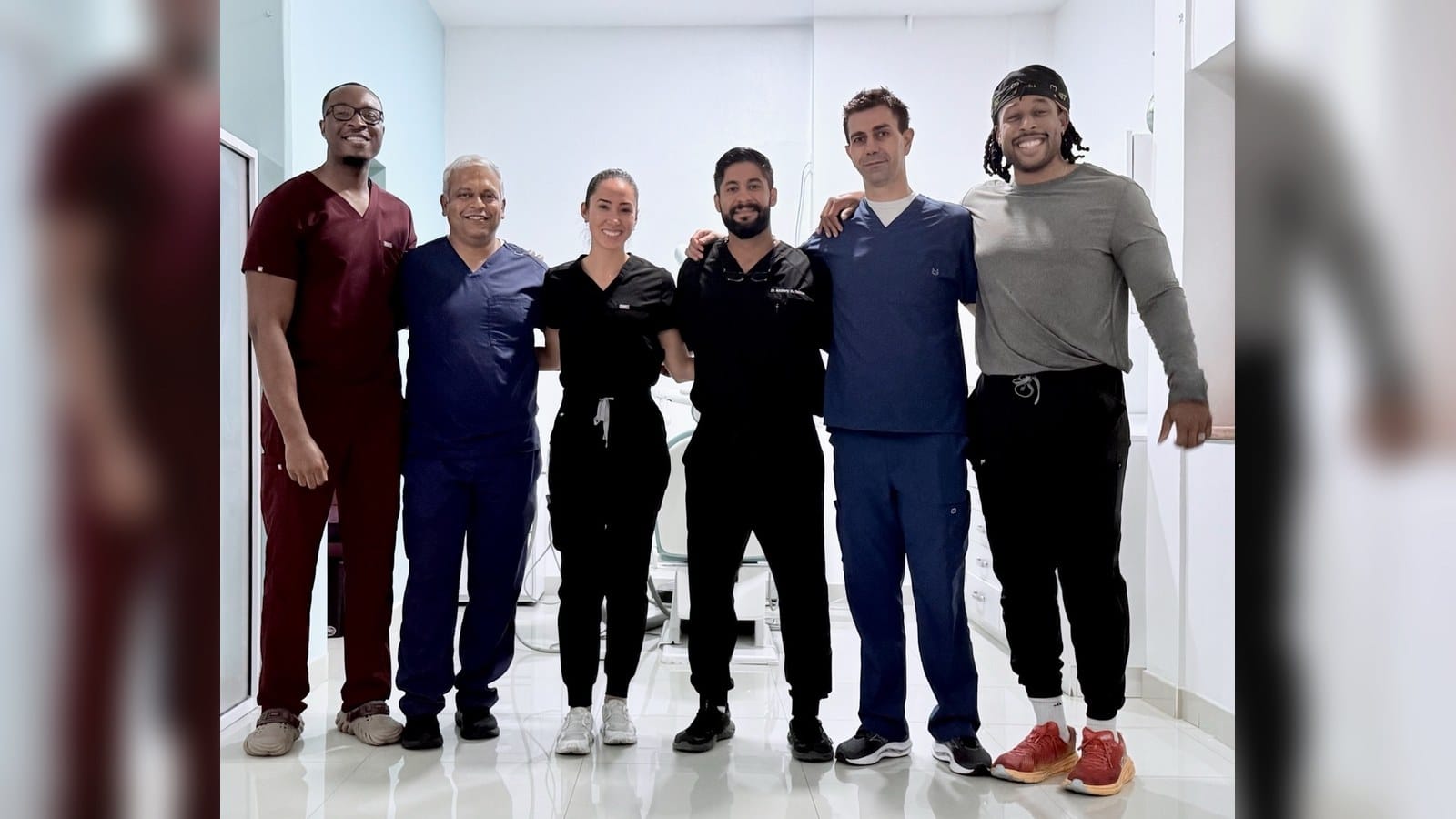
- Ratio: groups are capped at five dentists with two mentors present during surgery.
- Case planning: the curriculum runs from diagnosis to postoperative review. Participants review anatomy, medical risk, CBCT findings, and implant sizing, and the five-doctor cap with two mentors is there so planning feedback stays close to each participant.
- Case selection: case selection is a named curriculum item, and the curriculum explicitly covers when a case should be delayed or referred rather than treated.
- Treatment acceptance: our published curriculum is clinical — treatment planning, placement, grafting, soft tissue, and complications. It does not currently include a formal treatment acceptance or case presentation module. We are telling you that plainly because criterion 5 is one most programs quietly skip, and you should be able to check it on us as easily as on anyone else.
- Mentorship: mentorship during the course is chairside on every procedure. If ongoing case review after you get home matters to your decision — and by criterion 6 it should — ask us directly what is available rather than assuming, and hold us to the same standard of a specific answer.
- Accreditation and cost: 36 CE credits through MINEC America under AGD PACE, AGD code 690. Tuition is $16,000 and is all-inclusive; an observer option is available at $3,000 with 22 CE credits.
Course dates, seat availability, and the full inclusion list are on the implant course page, common questions are answered on the course FAQ, and past participants describe their own experience in our reviews. Compare all of it against whatever else is on your shortlist.
Frequently asked questions
What should a dental implant CE program teach about case planning?
A dental implant CE program should teach case planning as a repeatable workflow rather than a lecture topic: reading a CBCT for bone volume and vital structures, working backwards from the planned restoration to the implant position, choosing implant diameter and length against the site, recognising when grafting is required, and identifying the cases that should be referred out. Ask whether participants plan their own cases before surgery and whether a mentor reviews those plans with them individually.
Do implant CE courses teach treatment acceptance and case presentation?
Most do not, and it is one of the largest gaps in implant continuing education. Surgical skill produces no cases if the treatment plan is never accepted, and dentists who return from training frequently find that the barrier is the consultation rather than the surgery. Look for programs that cover how to explain implant treatment to a patient, how to present fees without discounting, how to handle the common objections, and how the front office supports the conversation.
What does post-training mentorship in implant CE usually include?
Post-training mentorship varies enormously in substance. At its weakest it is a course email address. Stronger arrangements include named faculty who will review a planned case before you operate, a channel where you can send a CBCT and get a specific answer, defined access to that support after the course ends, and a route to discuss a complication when one occurs. Ask who answers, how quickly, for how long, and whether it costs extra.
Why does group size matter in a dental implant course?
Group size determines how much of the course you spend operating rather than watching. A small-group dental implant course concentrates mentor attention on each participant, allows a mentor to correct technique in the moment rather than afterwards, and raises the number of surgical repetitions each dentist personally performs. Ask for the maximum group size and the number of mentors present in the surgical suite, not the total number of faculty associated with the program.
How do I verify hands-on implant surgery training claims before enrolling?
Ask the program to put the specifics in writing: how many implants you personally place rather than the group total, whether the placements are on live patients or models, the maximum group size, the number of mentors in the operatory, who screens and consents the patients, and who provides follow-up care afterwards. A program that trains dentists routinely will answer these without hesitation. Vague or shifting answers are the signal.
Should I evaluate implant CE programs on CE hours or on surgical repetitions?
Both matter, but they measure different things. CE hours record attendance and satisfy licensure requirements. Surgical repetitions build the motor memory and decision-making that let you operate independently. Two programs can carry identical credit hours while one gives a participant a dozen live placements and the other gives none. Use CE hours to confirm the credit is board-acceptable, and use per-participant repetitions to judge whether the course will change what you can do.
What is a reasonable mentor-to-participant ratio for implant surgery training?
There is no accredited standard, but the ratio is one of the few numbers that reliably predicts how much individual correction you receive. Large lecture-style programs may run dozens of participants to one presenter, which is appropriate for didactic content and inadequate for surgery. For live surgical training, programs that keep participants in low single digits per mentor can supervise each placement directly. Ask for the ratio in the operatory specifically.
How soon after implant CE should a dentist place a first case?
Sooner is generally better, because surgical skill decays without use. Clinicians who schedule a straightforward, well-screened case within the first weeks of returning tend to retain what they learned, while those who wait months often need to retrain. This is a practical reason to evaluate a program on whether it helps you build a case list and plan your first cases before you travel home, not only on what happens during the course itself.
Is a weekend implant course enough to start placing implants?
A weekend course is usually enough to understand a protocol and not enough to build surgical reflexes. Two days caps the number of implants any one participant can personally place, and confidence comes from supervised repetition rather than from lecture hours. A weekend format works well as an introduction, as a refresher on a specific technique, or as an inexpensive way to evaluate faculty before committing to a longer program — but a general dentist moving from referring cases to placing them will generally need more repetitions than two days can hold.
How much production does a private practice lose attending implant CE?
Multiply your own average daily production by the total number of days the practice runs without you, then multiply that by the number of separate trips the program requires. For most owner-operators this figure exceeds tuition, which is why a continuum spread across six or eight travel dates often costs more in total than an intensive block of consecutive days. An associate or a hygiene schedule that keeps producing while you are away reduces the number substantially, so use your own figures rather than a rule of thumb.
What should a practice owner arrange before attending an implant course?
Block the schedule far enough ahead that hygiene and recall are not disrupted, decide which cases you intend to treatment-plan during your first week back, confirm that the implant system and surgical kit in your practice match the ones you will train on, and identify the specialist you will call for a second opinion. Surgical skill decays without use, so the value of the course depends heavily on whether a first case is waiting when you return.
Run the nine on your shortlist
Take the two or three programs you are seriously considering and put the nine questions to each of them in the same week. You are not only collecting answers — you are watching how quickly and how specifically each program produces them. A provider that trains dentists routinely has these numbers on hand. A provider that hesitates, redirects, or answers a different question has told you where it is weakest, which is exactly what you were trying to find out.
The decision underneath all nine is the same one: not which implant CE program is best, but what will I be able to do, on my own patients, the Monday after I get home. Every criterion above is a way of forcing a brochure to answer that question.